

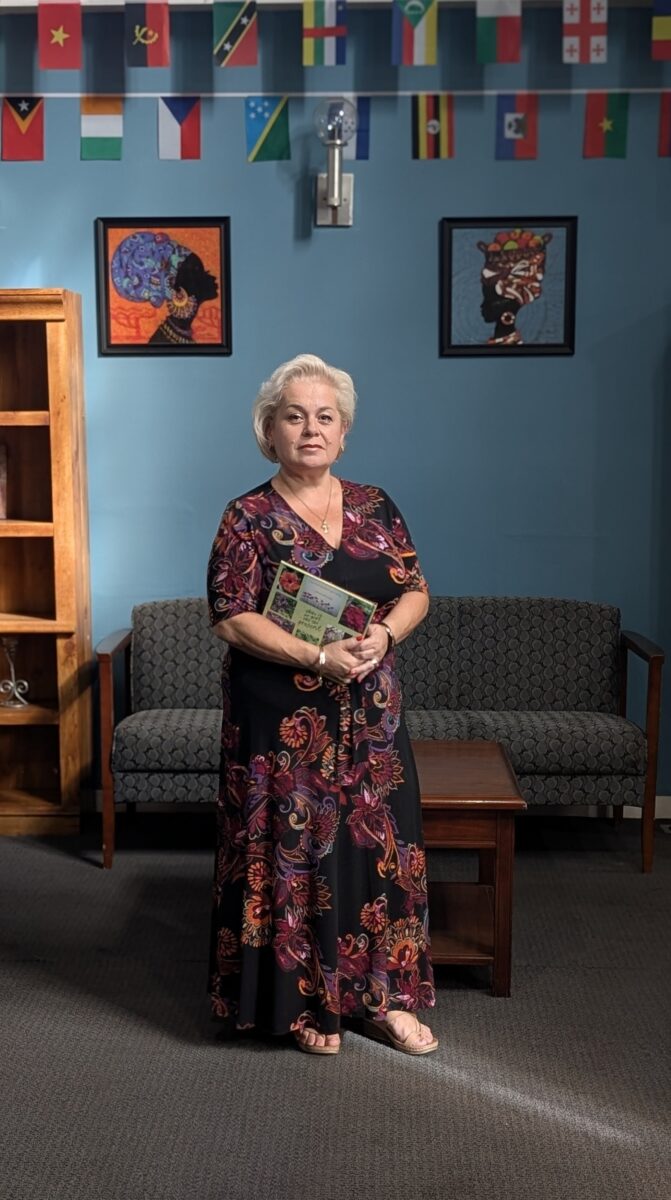
“When we came here to the United States from Macedonia, former Yugoslavia, we came straight here to Columbus. I was in my second semester of sophomore year in high school. Being a teenager can be very difficult. Now, imagine taking a teenager and taking them someplace else that is like a totally different world.
I did take some English classes back home, but how much do you remember from taking a foreign language? I only knew the days of the week, the months, the colors. I claimed to know how to read in English, but whatever I was reading, I probably didn’t comprehend. I had an English teacher who told me right in my face that she wished that all of us foreigners went back to where we came from. And that hit me like a punch in my gut. I didn’t know enough English to have a comeback.
I just thought, ‘what did I ever do to you?’ to deserve this. We all come here for better opportunities, a better life, and all that. And at that time, I’d always wanted to be a teacher. But then I decided that I was going to dedicate my life to working with immigrant and refugee families.
One summer, I had a friend who worked here and told me ETSS was looking for employees. I got a job teaching English as a second language, and the rest is history. I just fell in love with the non-profit world.
We started our resettlement program in 2021 with the influx of Afghans when US troops pulled out of Afghanistan and the Taliban took over. There were a lot of Afghan families who were targeted by the Taliban because they were working with our government and our troops. And then, the following year, we officially became a resettlement office, and we resettled refugees from all over the world.
We helped families find an apartment, find jobs, help them with getting their kids enrolled in school, or just take them to the grocery store to teach them how to buy groceries. These are little things, but it may be overwhelming and intense. We’ve worked with families that have been in refugee camps for almost 20 years, and this is a totally different world for them.
Our reception and placement period for resettling these families would end at 90 days, and they were just so grateful and appreciative. They knew from then on they would have a future.
We were expecting some government changes, but we never expected them to be this severe. I remember I woke up to the stop-work order and the ban list of all of the countries where all of our clients were coming from. Our budget was frozen. We literally had a family that came that Friday before. A single mother with four children from Somalia with no family here, no US ties. We put her in a hotel and we told her not to worry, that we would be helping her for the next 90 days. Well on Tuesday we had to go back to her and tell her our new president told us to stop working with you and with all the refugees. She spoke no English at all, with four children in a hotel, and nowhere to go. She didn’t know anything about this country and was afraid to walk out of that room.
It was heartbreaking. Not just for her, but everybody else. We had to visit every single one of our families to explain what was happening, and many of them said they were sorry. I was like, ‘why are you sorry? I should be the one that should be sorry.’ Our clients took it so well. They’re innocent in all of this. They’re just like, ‘Okay, that agency can’t help me anymore, but it’ll be fine. It’ll all work out. I’ve been through worse.’ They’re in America. They’re in the promised land. What can go wrong, right?
What I am most grateful about that time is that the community turned up. We gained so many volunteers who did the work for free. They organized donation events so they got grocery gift cards, clothes, and housing items. It was heartwarming. I think I cried more than I smiled. It shouldn’t have been that way.
We held off for a few weeks, hoping the executive order would be lifted. But it was not. We lost 75 percent of our Resettlement Department staff. It was down to just four of us left, and that was the hardest time of my professional life. It was my job to let them go. Single mothers. People I had just hired a month prior. Fathers who were the breadwinners of their families. How do you tell a father of five and six that he no longer will have a job? I was falling apart. I was hiding my face behind the monitor, and I felt like I was melting, like my soul was leaving. This place became very lonely, very quiet.
But life must go on, and we have to do what we have to do. There is some money left to support four of us so we can continue to work with the individuals that are at least here. It’s long-term intensive case management for up to a year. We have clients that may have physical or mental challenges. These individuals are survivors of war, torture, domestic violence, you name it. They have all kinds of health issues and can’t keep working. At least we get to help them.
As an immigrant myself, I can say we did not come to this country because we just simply wanted to. Yugoslavia had started falling apart, and my parents decided to come here because my mom’s family was here. There’s a lot of people who are just putting the refugees and the immigrants in one pot, and identifying them all as illegals. I hate that word.
The fastest growing population here in central Ohio is the new American Community, many of them are entrepreneurs. So we don’t come here to be taken care of by the government. We want to have a good and productive life and become part of the US.
I hope we can get back to doing the resettlement work some day. It is the most fulfilling work. It is my light. But it is also so hard. I just know, every night, when my head hits my pillow, that I did something to help someone else, and that is enough. It has to be enough.”
Tatjana Bozhinovski is the Resettlement Program Director for ETSS, an organization that works with immigrants and refugees to help improve quality of life through education, training, supportive services, and self-development opportunities while increasing awareness of the diverse cultures and heritage.