


This guest blog post was provided by the Health Policy Institute of Ohio.
Recent federal policy changes from HR 1, the 2025 federal reconciliation bill sometimes referred to as the “One Big Beautiful Bill Act” or the “Working Families Tax Cuts Act,” will impact services for Ohioans related to healthcare, housing, food access and more.
Changes to Ohio’s Medicaid Program
HR 1 includes many provisions that will affect Ohio’s Medicaid program, including work requirements for the Medicaid expansion population (adults ages 19-64 with low incomes), limitations to eligibility for some immigrant populations, restrictions on how states finance their programs, and more.
The 2014 expansion of Medicaid eligibility in Ohio contributed to a significant decrease in the state’s uninsured rate, particularly the percentage of working-age Ohio adults with lower incomes who did not have coverage.
Given the changes to Medicaid eligibility in HR 1, many Ohioans will likely become uninsured in the coming years.
Work requirements in Ohio will go into effect in January. According to new projections from healthcare consulting firm Manatt, Ohio is expected to see its Medicaid enrollment drop by 305,000, or 10%, by 2028 because of the work requirements. Nearly all the people who lose their Medicaid coverage will become uninsured because they will not have access to other forms of health insurance.
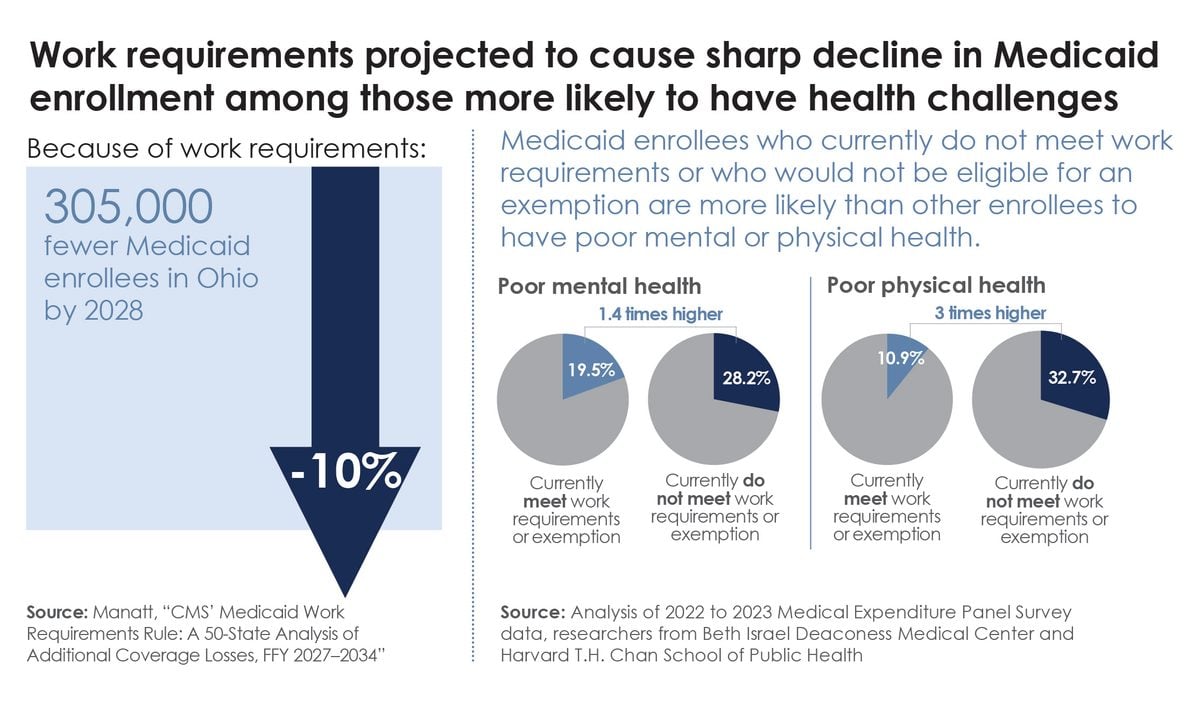
National analysis conducted earlier this year found that those at risk of losing coverage tend to have greater health challenges than those who are at less risk to meet the work requirements (see this Health Policy Institute of Ohio (HPIO) data graphic for more details).
HPIO recently released a policy update on the implementation of Medicaid work requirements in Ohio.
Changes to SNAP in Ohio
HR 1 also made substantial changes to the Supplemental Nutrition Assistance Program (SNAP) that will affect eligibility for the program, as well as how Ohio and other states administer it.
Beginning in October 2026, the federal government will cover 25% of SNAP administrative costs, rather than 50%, resulting in a $67 million loss for Ohio, according to estimates from the Ohio Department of Job and Family Services. States will also have to pay a portion of SNAP benefit costs based on their payment error rate. Overall, the Georgetown Center on Poverty and Inequality estimates that Ohio’s share of SNAP costs will increase by nearly 270% due to HR 1.
Additionally, HR 1 restricts SNAP eligibility in Ohio. Many immigrant populations no longer qualify for the program, including refugees, asylees and victims of domestic violence and human trafficking. Further, some program participants who were previously exempt from work requirements will now need to demonstrate compliance, including older Ohioans and parents of children over the age of 13. Research on SNAP work requirements suggests that they decrease program participation but do not increase employment rates. Even if participants meet requirements, they may experience barriers to verifying compliance, such as difficulties finding transportation to meet with a caseworker.
To learn more about the impacts of federal policy on Ohio’s SNAP program, see HPIO’s SNAP at a Glance: Key Changes from HR 1.
More HPIO resources on federal health policy impact on Ohio and healthcare access and affordability in Ohio are available on the Institute’s website.